
A large tree close to your house is not automatically a reason to remove it. Healthy, well-maintained trees can provide shade, privacy, wind protection, and visual appeal. However, a tree growing too close to a home can create problems when its branches reach the roof, the tree becomes structurally unstable, or its roots interfere with nearby structures and utilities.
So, should you cut down a tree close to your house? It depends on the tree’s condition, size, location, species, root system, and the potential consequences if it fails. In many cases, professional trimming or pruning can address the problem without removing the tree. In other situations, removal may be the safest option.
Understanding what to look for can help you decide what to do next.
How Close Is Too Close for a Tree?
There is no single distance that makes every tree too close to a house. A tree’s mature size, species, growth pattern, condition, and surrounding structures all matter.
A small ornamental tree may be able to grow relatively close to a house without creating significant problems. A large mature tree with heavy limbs, extensive roots, or a leaning trunk presents different considerations.
Trees also do not confine their roots to the area directly beneath their canopy. Tree roots can extend well beyond the drip line, and most roots are relatively shallow. University extension guidance notes that construction, grading, trenching, and other disturbances near established trees can damage these roots and potentially affect tree health.
Rather than focusing only on the number of feet between the trunk and your house, look at the entire relationship between the tree and the property.
Consider:
- How tall and wide the tree is
- How close the branches are to the roof
- Whether limbs hang over the house
- Whether the tree is leaning
- Whether the trunk has cracks, cavities, or decay
- Whether large branches are dead or damaged
- Whether roots are affecting sidewalks, driveways, or other structures
- Whether the tree has been damaged by wind, snow, or construction
- Whether the tree is likely to grow significantly larger
- Whether removing the tree would create other problems, such as soil erosion or loss of stability on a slope
A professional tree assessment can help determine whether the tree can safely remain.
When Should You Consider Cutting Down a Tree Near Your House?
Proximity alone is not necessarily a reason for tree removal. However, several warning signs can make removal worth considering.
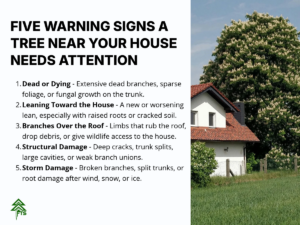
1. The Tree Is Dead or Dying
A dead tree near a house can become a significant hazard because branches and entire sections of the tree may fail unexpectedly.
Signs of decline can include:
- Extensive dead branches
- Sparse or declining foliage
- Large areas of missing bark
- Fungal growth associated with decay
- Cavities in the trunk
- Cracks or splits
- Significant dieback
- Loose or hanging branches
A tree does not necessarily need to be removed simply because it has some dead branches. Dead limbs can sometimes be removed through proper pruning. However, extensive decay or structural problems may make the entire tree unsafe.
2. The Tree Is Leaning Toward the House
A noticeable lean deserves attention, particularly if the tree has recently changed position.
A naturally leaning tree that has remained stable for many years may not present the same risk as a tree that has recently started leaning because of root damage, soil movement, storms, or structural failure.
Look for additional signs such as:
- Raised or exposed roots
- Cracked or disturbed soil around the trunk
- A newly developed lean
- Trunk cracks
- Broken roots
- Significant branch loss
If you notice these problems, avoid trying to correct the situation yourself. A professional can assess whether the tree can remain safely in place.
3. Large Branches Are Overhanging the Roof
Branches that extend over your roof can create maintenance and safety concerns.
They may:
- Drop branches onto the roof
- Rub against roofing materials
- Deposit leaves and debris into gutters
- Provide access for wildlife
- Become more hazardous during severe weather
A tree does not necessarily have to be removed because its branches reach the roof. Selective pruning may provide adequate clearance while preserving the tree.
The key is to have branches evaluated and pruned appropriately rather than simply cutting large sections without a plan.
4. The Tree Has Structural Damage
Structural defects can increase the likelihood of branch or tree failure.
Pay particular attention to:
- Deep cracks
- Trunk splits
- Weak branch unions
- Large cavities
- Extensive decay
- Broken major limbs
- Damaged roots
- Multiple trunks with weak attachments
Some defects can be managed through pruning or other tree-care techniques. Others may indicate that removal is the safer option, particularly when the tree is close to an occupied structure.
5. The Tree Has Been Damaged by a Storm
Wind, heavy snow, ice, and other severe weather can cause damage that is not always immediately obvious.
A storm-damaged tree may have:
- Broken branches
- Split trunks
- Hanging limbs
- Exposed roots
- Cracked branch unions
- A newly developed lean
- Damage to the root system
Trees near houses deserve particular attention after major storms because a failed branch or tree can damage roofs, siding, windows, vehicles, and other property.
If a large tree has fallen or is partially suspended, keep people away from the area and have the situation assessed professionally.
Can Tree Roots Damage Your House?
Tree roots are one of the biggest concerns homeowners have when a tree is close to a house. However, the relationship between roots and foundations is more complicated than simply saying that roots will “break” a foundation.
Healthy foundation walls generally provide a substantial physical barrier. Extension experts note that roots often take advantage of existing cracks, openings, or areas where soil conditions provide easier growth rather than simply forcing their way through solid, intact concrete.
Roots can still contribute to property problems in certain situations. They may affect:
- Sidewalks
- Driveways
- Patios
- Retaining walls
- Drainage systems
- Underground utilities
- Existing foundation cracks
Roots can also be damaged by construction, excavation, grading, and trenching. Because much of a mature tree’s root system is relatively shallow, digging or changing the soil around a tree can affect its stability and health.
If you are concerned about roots near your foundation, do not automatically assume that cutting the tree down is the answer. A tree professional and, when appropriate, a structural professional can help determine the actual cause of a foundation problem.
What About Tree Roots Growing Under the House?
Seeing roots close to a foundation can be alarming, but their presence does not automatically mean the tree is damaging the house.
Tree roots typically grow where conditions provide adequate oxygen, moisture, and nutrients. They can extend farther from the trunk than many homeowners expect. Extension guidance notes that roots may extend beyond the tree’s canopy and that most roots are found relatively close to the soil surface.
If roots are lifting a walkway, affecting a driveway, or appearing near a foundation, avoid cutting them yourself. Removing major roots can weaken a tree’s stability or health. Root damage may also take months or even years to show visible symptoms.
A professional should determine whether the root can safely be pruned, whether another solution is possible, or whether tree removal should be considered.
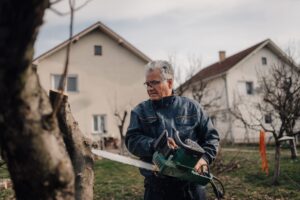
When Trimming May Be Better Than Removing the Tree
Tree removal is permanent. If the tree is healthy and structurally sound, pruning may solve the problem while allowing you to keep the benefits of the tree.
Professional pruning may help when:
- Branches are touching the roof
- Limbs extend toward windows
- Dead branches need to be removed
- The canopy needs selective reduction
- Branches are interfering with structures
- The tree needs better clearance from the house
- Certain limbs are growing in an undesirable direction
The goal should be to address the specific problem rather than remove more of the tree than necessary. A qualified tree professional can determine which branches should be removed and how much pruning is appropriate for the tree.
Should You Remove a Tree That Is Touching Your Roof?
Not necessarily.
A branch touching or rubbing against your roof should be addressed, but that does not automatically mean the entire tree needs to come down. Depending on the tree’s condition and structure, selective pruning may create enough clearance to prevent further contact.
However, if the tree is large, unstable, severely decayed, or positioned in a way that makes failure particularly dangerous, removal may be more appropriate. The important distinction is between a tree that is simply close to the house and a tree that presents an unacceptable structural or safety risk.
What If the Tree Is Very Large?
Large trees deserve additional consideration when they are close to a house because their potential failure zone is greater.
A large branch falling from considerable height can cause substantial damage even if the tree itself remains standing.
For a large tree near your home, inspect it for:
- Dead or hanging branches
- Cracks
- Decay
- Leaning
- Root damage
- Weak branch attachments
- Storm damage
- Signs of declining health
Large trees are also more difficult and dangerous to remove. Attempting DIY removal with a chainsaw can put homeowners, nearby people, structures, and utility lines at risk. For trees of significant size, professional assessment and removal are generally much safer than attempting to handle the work yourself.
What About Trees Near Power Lines?
Trees growing close to overhead power lines require additional caution. Do not attempt to cut branches that are touching or growing toward electrical lines yourself. Even branches that do not appear to be in direct contact can create dangerous conditions during cutting.
The appropriate response depends on the type of utility line, the tree’s location, and the local utility provider’s requirements. When a tree is growing around utility infrastructure, have the situation evaluated before doing any cutting.
How Montana Weather Can Affect Trees Near Homes
For homeowners in Montana, seasonal weather is another factor to consider.
Trees can experience stress or physical damage from:
- Heavy snow
- Strong winds
- Ice
- Rapid weather changes
- Winter storms
- Freeze-thaw conditions
Heavy snow can load branches and increase the likelihood of limb failure, while strong winds can expose weaknesses in branches, trunks, and root systems.
A tree that is already compromised may become significantly more hazardous after a severe weather event. This is especially important when the tree is close to a house, garage, driveway, or other frequently occupied area.
Should You Cut Down a Tree Close to Your House if It Is Healthy?
Not necessarily.
A healthy tree that happens to be close to a house may be able to remain in place for many years with appropriate maintenance. Before removing it, consider whether the actual concern can be addressed through:
- Proper pruning
- Deadwood removal
- Structural assessment
- Monitoring
- Improving the tree’s growing conditions
- Addressing drainage or soil issues
- Removing a specific hazardous limb
Tree removal should be based on the overall risk and condition of the tree rather than distance alone. In fact, extension guidance recommends treating removal as a last resort for healthy trees when other appropriate management options are available.
What Should You Do If You Are Unsure?
If you cannot tell whether a tree near your house is dangerous, the safest approach is to have it professionally evaluated.
An assessment can look at:
- Tree health – Is the tree actively growing and maintaining healthy foliage?
- Trunk condition – Are there cracks, cavities, decay, or other defects?
- Branch structure – Are there weak or damaged limbs?
- Root condition – Is there evidence of root damage or soil disturbance?
- Tree location – What would happen if the tree or a major branch failed?
- Recent changes – Has the tree recently started leaning or showing signs of decline?
- Surrounding property – Is the tree close to a house, garage, driveway, utility line, or other target?
The assessment should consider both the likelihood of failure and the potential consequences of failure. A tree in a remote portion of a large property may present a very different risk from a similar tree directly beside an occupied house.
Don’t Automatically Remove a Tree Just Because It Is Close
A tree growing close to your house deserves attention, but distance alone does not determine whether it needs to be removed.
A healthy, structurally sound tree may only need regular pruning and monitoring. On the other hand, a tree with severe decay, major structural defects, root damage, or a significant lean may present a serious hazard when it is close to a home.
If you’re asking, “Should I cut down a tree close to my house?”, start by looking at the tree’s condition rather than its distance from the house. Check for obvious signs of damage, consider how the tree could affect your property if it failed, and have a professional assess anything you’re uncertain about.
Getting an assessment before reaching for a chainsaw can help you protect both the tree and your property while making a more informed decision.
Related Posts
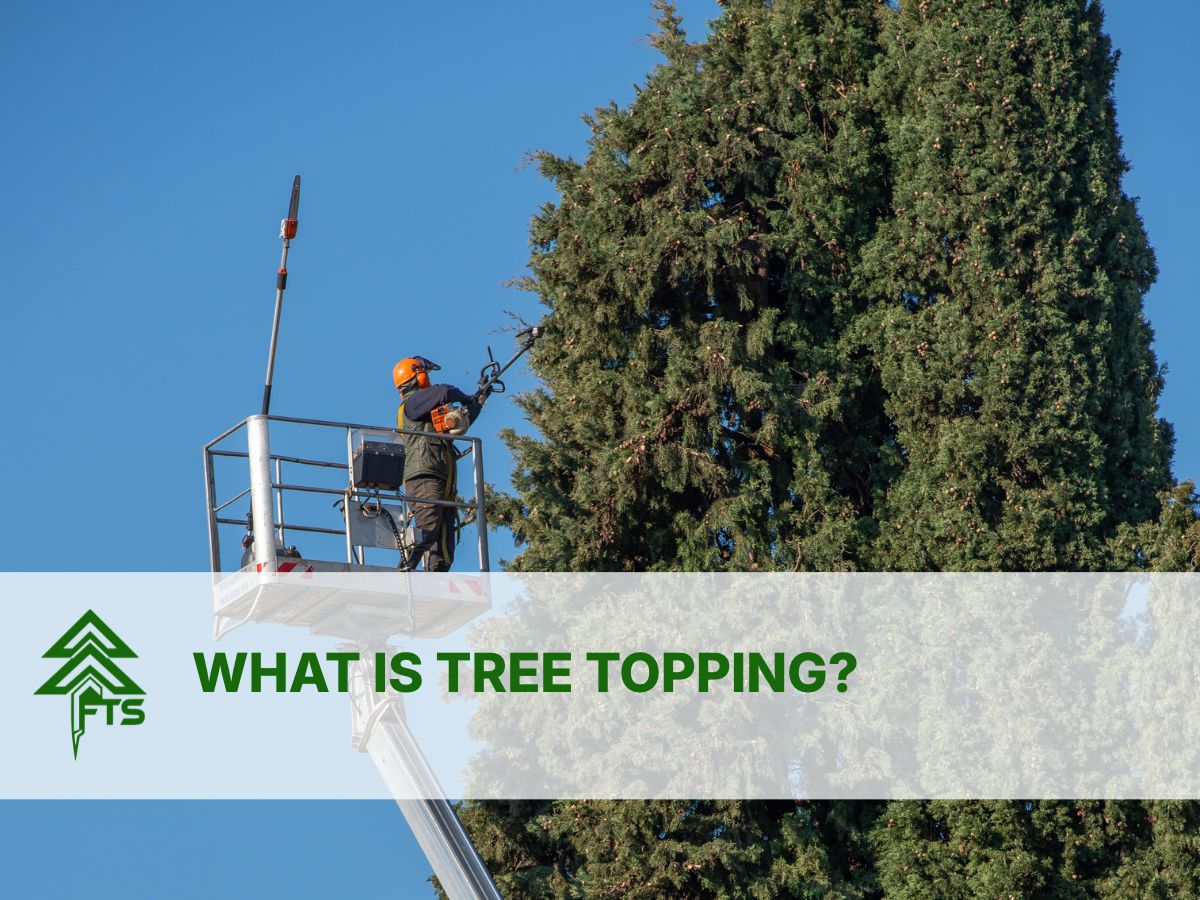
What Is Tree Topping?
Tree topping is the practice of cutting off the upper [...]
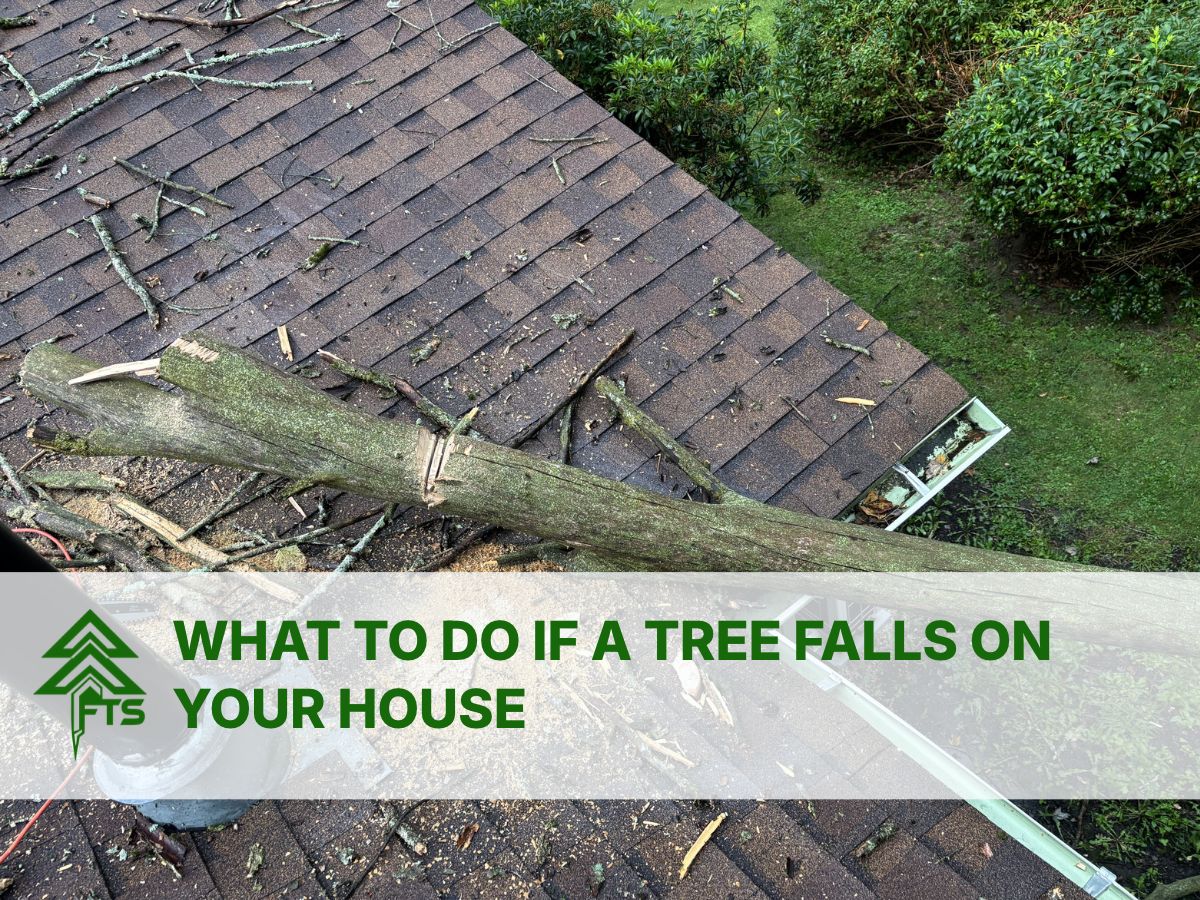
What to Do If a Tree Falls on Your House
If a tree falls on your house, prioritize everyone’s safety, [...]
Cheapest Time of Year to Have a Tree Cut Down
Tree removal costs vary significantly based on when the work [...]
How Much Does Land Clearing Cost in Montana?
Land clearing in Montana typically costs between $500 and $5,000 [...]
Categories